
Updated September 2026
Online, your brand is what customers remember after they close the tab: the promise you make, how you look and sound, and whether the order arrives the way you said it would. In 2026, when ad platforms automate much of the targeting and AI tools can produce endless content, a clear brand is what keeps your store recognizable, trusted and worth coming back to. Here is a practical framework for building one, and for measuring whether it is working.
Key takeaways
- Trust drives purchases: in Edelman’s 2025 research, 80% of people said they trust the brands they use, and trust now ranks alongside quality and price as a purchase consideration.
- Positioning comes first. One sentence about who you serve, what you solve and why you are different should guide every design, copy and ad decision.
- Consistency is operational: a simple brand kit and voice guide keep your store, ads, social, email and packaging aligned, even as creators and AI tools produce more of your content.
- Reviews and creator content must be genuine. The US FTC and the UK’s consumer law now ban fake reviews, and paid creator posts need clear disclosure.
- Measure brand with branded search, direct traffic, returning customer rate and review quality, not just likes and followers.
Why branding matters more for online stores in 2026
Shoppers can find a near-identical product from dozens of stores in seconds. Brand is what makes them choose yours, accept your price and come back without needing to be retargeted.
Edelman’s 2025 Trust Barometer special report on brands, based on 15,000 respondents in 15 countries, found that 80% of people trust the brands they use and that trust is now as much a purchase consideration as quality and price. The same research found that among people who use generative AI tools, 91% use them for shopping tasks such as researching brands and comparing products. Your product pages, reviews and brand story may be summarized by an AI assistant before a shopper ever visits your store, and clear, consistent information makes that summary more likely to be accurate.
Brand also matters in paid media. As ad platforms automate more of the targeting and bidding, your offer and creative are the main levers left in your hands, and a recognizable brand makes that creative work harder.
Start with positioning
Positioning is the decision about which customer you serve and why you are the best choice for them. Write it as one sentence:
For [specific customer] who [need or frustration], [brand] is the [category] that [key benefit], because [proof].
Then test it:
- Is the customer specific? “Women aged 25 to 45” is a demographic; “new runners training for their first half marathon” is a customer.
- Is the benefit different? If every competitor already claims it, it won’t set you apart.
- Can you prove it? Materials, testing, guarantees, founder expertise and reviews all count as proof.
- Does your pricing match? A premium promise with bargain-bin pricing confuses people.
Positioning also tells you what to say no to. If a product, promotion or partnership doesn’t fit, skip it.
Visual identity that works on small screens
Most people will meet your brand on a phone, often inside a social feed. Design for that first:
- Logo: a simple wordmark or symbol that stays legible as a small profile picture and a browser icon.
- Color: one or two primary colors, a neutral palette and one accent for buttons. Check contrast: WCAG 2.2 asks for at least 4.5:1 for normal text and 3:1 for large text.
- Typography: one heading and one body typeface that load quickly on mobile.
- Photo and video style: define lighting, backgrounds, angles and how people appear, so product shots, lifestyle images and creator content feel like one brand.
- Templates: ready-made layouts for ads, stories, emails and product images save time and prevent drift.
Your store is where everything comes together, and a fast, clean theme does more for brand perception than any logo. If your current store doesn’t reflect your brand, our Shopify store design and development service can help.
Brand voice: how you sound everywhere
Voice is your personality in words. Pick three or four traits and show what each looks like in practice:
| We are | We are not | Example |
|---|---|---|
| Confident | Arrogant | “Made to be used every day. Here’s how it holds up.” |
| Friendly | Overly casual | “Your order is on its way. Here’s your tracking link.” |
| Clear | Vague or technical | “Fits true to size. Between sizes? Go up.” |
| Helpful | Pushy | “Not sure which one? Take our quick fit quiz.” |
Apply it where brands often forget: product descriptions, order confirmations, shipping delay notices, returns pages, customer service replies and error messages.
Consistency across store, ads, social and email
Consistency doesn’t mean every post looks the same. It means a customer could recognize you with the logo covered.
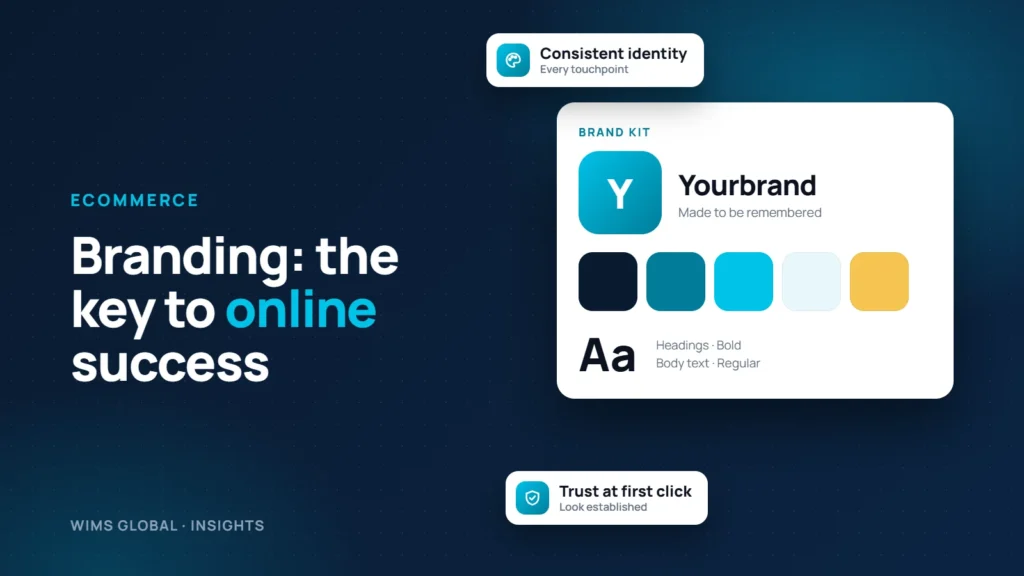
- Create a one-page brand kit: logo files, colors, fonts, photo rules, voice traits and examples of what to do and avoid. Share it with your team, freelancers, agencies and creators.
- Match ads to landing pages: the offer, visuals and tone of an ad should continue on the page it links to. Our guide to Facebook and Instagram ads for e-commerce covers this in more detail.
- Align your profiles: use the same name, bio style, profile image and link structure across Instagram, Facebook, TikTok, YouTube, Pinterest and X (formerly Twitter).
- Make email feel like the store: use brand fonts, colors and voice in email and SMS, including automated welcome, abandoned cart and post-purchase flows.
- Review monthly: put your latest ads, emails and posts side by side and flag anything that feels off-brand.
Trust signals and reviews
New visitors look for proof that you are real and reliable. Make these easy to find:
- Clear shipping times and costs, a readable returns policy and real contact details.
- Recent customer reviews with photos, including critical ones answered politely.
- Familiar payment options at checkout; see our guide to payment gateways.
- An About page with real people and your story.
- Fast, human customer service in your brand voice.
Reviews must be genuine. The FTC’s rule on consumer reviews and testimonials, in effect since October 21, 2024, bans fake reviews (including AI-generated fake reviews), incentives conditioned on a particular sentiment, undisclosed insider reviews and review suppression, and courts can impose civil penalties for knowing violations. In the UK, the Digital Markets, Competition and Consumers Act banned fake reviews and misleading review practices, such as hiding negative reviews, from 6 April 2025, with potential fines of up to 10% of global turnover.
The safest approach is also the simplest: ask every customer for a review after delivery, publish them all, and reply to criticism calmly and in your brand voice.
Packaging and the unboxing moment
For an online brand, the parcel is the first physical contact with a customer. It doesn’t have to be expensive to feel intentional:
- A branded box or mailer, or simply branded tape and a sticker.
- A short insert with a thank-you note, care or usage tips and a QR code to reorder, leave a review or join your list.
- Right-sized packaging that protects the product without excess filler.
- Colors and tone that match your website and ads.
If you ship to the EU, plan ahead: the Packaging and Packaging Waste Regulation has applied since 12 August 2026, with harmonized sorting labels due in 2028 and new limits on empty space in packaging among the measures that follow in 2030.
UGC, creators and influencers
Customers trust other customers, which is why user-generated content (UGC) and creator partnerships have become core brand channels. The IAB projected US creator economy ad spend of $37 billion in 2025, up 26% year over year, with 48% of buyers now calling creators a “must buy” channel.
- Brief creators on the brand, not a script: share your positioning, voice traits, product facts and claims to avoid, then let them speak naturally.
- Run the best posts as ads: TikTok’s Spark Ads and Meta’s partnership ads let you promote creator content from the creator’s own handle, with their authorization.
- Disclose every paid relationship: the FTC’s Endorsement Guides expect clear disclosures such as “#ad” or “Paid post” and hold the brand ultimately responsible for what others do on its behalf.
- Collect customer content: ask buyers for photos and videos with their reviews, and get permission before reusing them.
Our influencer marketing service can help you find, brief and manage creators who fit your brand.
AI-generated content without losing your brand
Generative AI now helps with product copy, image editing, ad variations and email drafts. Shopify’s Sidekick, for example, can write product descriptions and turn phone photos into studio-style shots. The same IAB report found that nearly three in four creator ad buyers use or plan to use AI, yet 95% have concerns about it, with loss of human connection the top worry.
- Feed tools your brand kit: include voice traits, banned words, product facts and example copy in every prompt or tool setting.
- Keep a human editor: check every claim, size, ingredient and price before anything goes live.
- Don’t fake reality: product images must show what customers will receive, and invented customers or testimonials are both a legal and a trust risk.
- Label where required: Meta shows an “AI info” label on ads created or significantly edited with its generative AI tools; TikTok requires creators to label realistic AI-generated content and auto-labels content carrying C2PA Content Credentials; and the EU AI Act’s transparency rules, applying from 2 August 2026, require deepfakes to be clearly disclosed.
How to measure your brand
Brand building takes time, but it can be measured. Track a handful of signals monthly:
| Metric | What it tells you | Where to find it |
|---|---|---|
| Branded search clicks and impressions | Whether more people look for you by name | Google Search Console branded queries filter |
| Direct and branded traffic | People coming straight to you rather than via ads | GA4 traffic acquisition |
| Returning customer rate | Whether buyers come back | Shopify customer reports |
| Review rating and volume | Satisfaction and social proof | Your reviews app, Google |
| Ad recall and awareness lift | Whether campaigns change perception | Brand lift studies |
Search Console’s branded queries filter, available to all eligible sites since March 2026, uses an AI-assisted system to separate branded from non-branded searches, including typos and product names, and adds a branded versus non-branded clicks card to the Insights report. It works for top-level properties with enough search volume.
For repeat purchase, Shopify’s customer reports include returning customers, cohort analysis and RFM analysis. If you run YouTube or Demand Gen campaigns, Google’s Brand Lift surveys measure ad recall, awareness and consideration, though access requires contacting a Google representative.
A note for brands in the UAE and GCC
If you sell in the UAE or the wider Gulf, create Arabic and English versions of your core assets (logo lockups, product copy, customer service templates) from the start rather than translating later. Keep the same positioning in both languages, let a native writer adapt the voice, and plan campaigns around local moments such as Ramadan and Eid.
Frequently asked questions
What is e-commerce branding?
It is how your online store is perceived: your positioning, name, visual identity, voice, customer experience and reputation. It shows up at every touchpoint, from ads and product pages to packaging and customer service.
How long does it take to build an e-commerce brand?
You can define positioning, identity and voice in a few weeks. Recognition takes longer and depends on how consistently you show up and how good the product experience is, so track branded search and returning customers monthly.
Can a small store build a brand on a limited budget?
Yes. A clear niche, a consistent look and voice, genuine reviews, fast service and thoughtful packaging cost little compared with paid media, and they make every ad work harder.
Is it okay to use AI to create brand content?
Yes, with guardrails. Give AI tools your brand guidelines, have a person review every output, never fabricate reviews or misrepresent products, and follow platform and legal labeling rules for realistic AI images and video.
A strong brand turns one-time buyers into repeat customers and makes every marketing dollar go further. If you want help sharpening your positioning, refreshing your store or keeping your ads, social and email on-brand, explore our web design and development and paid social services, or start with a free digital audit of your brand and store.